

A friendly reminder that you are more than your job title
That question seems simple enough but it certainly stumped my client who, after 10 years in the same role, recently learned that their role was being eliminated. See, they loved their job and identified so strongly with it that the idea of it being taken away from them left them feeling lost and completely aimless. And they couldn’t think of a way to describe themselves without referring to that role. It was hard for them to figure out what they should do next.
In that session, we went on to discuss how they could go about disentangling their own identity from their job title.
To answer this question, I like to use the analogy of the tree. A tree has certain characteristics that differentiate a palm from an elm from a sequoia. Seasons pass, leaves fall and then they grow back, new branches form, and yet the core characteristics of that tree remain intact while the depth of its roots and the breadth of its branches expand.
If you are a tree and your “who” were the roots, what characteristics, traits, or capabilities could represent those roots? When you peel back the layers of titles and roles and get to your foundational attributes, what do you find? What is that unshakeable, resilient, authentic version of you thriving underneath?
Consider these three questions to SET your foundation and articulate who you are to others in a more nuanced way:
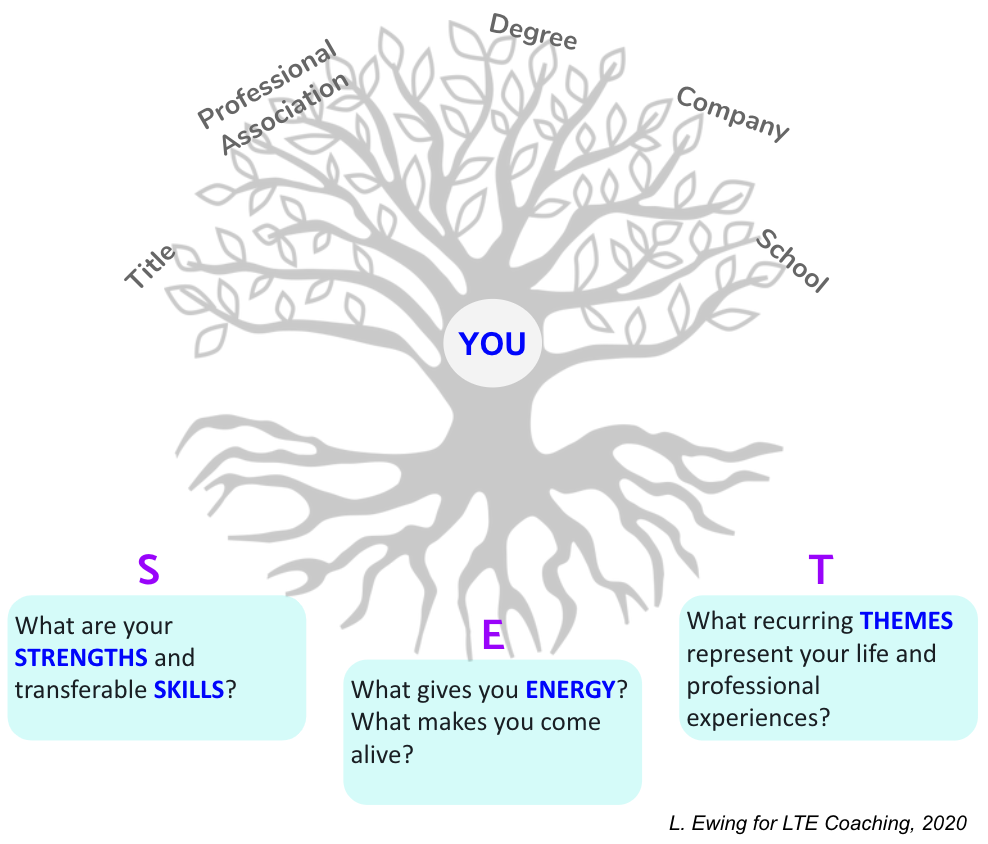
The “Who are you?” question often comes up in networking environments, a context that can feel forced, awkward, and pressure-filled, especially for those among us who are more introverted. I came up with the SET approach several years ago as a means of overcoming self-consciousness and anxiety while networking, and it has enabled me to relax for one main reason.
This SET formula for describing who you are is essentially an elevator pitch that pivots away from seeking favor or validation from others and instead focuses on the connection you have with yourself. If you are connected with yourself, then describing who you are will become second nature, and you will carry that connectedness with you whether you’re networking, interviewing for a job, considering career opportunities, or seeking to advance in various ways. As you work on composing your SET statement, keep in mind that it should be crisp, concise, and delivered with energy (which should be easy, especially if you approached question #2 thoughtfully). Developing 30-second, one-minute, and 3-minute versions of your SET statement would be a worthwhile exercise so that you can adapt to any situation that calls for you to use it.
All of that being said, allow me to reintroduce myself:
Hello, my name is Lauren and I am a “people person”, through and through. A natural problem solver and experienced strategist, I love tackling complex human capital and organizational challenges with an eye toward innovative solutions. I’m a systems thinker who excels in finding and creating connections while effectively synthesizing and simplifying complex concepts. I am also a master coach with proven experience in helping individuals unlock their potential and live full out. I thrive in environments where I can play at the intersection of art, science, and technology.
I look forward to meeting “you” soon, and I’d love to help you rediscover who you are. Once you’re SET, you’ll be one step closer to connecting to your purpose. So for your next networking opportunity, I challenge you to get ready, get SET, and go!
Stay tuned for a deeper dive into my SET framework. You can also feel free to share feedback by commenting on this post or reaching out for more information.