

Does your organization’s real culture match its stated values? Discover how long-tenured employees, tolerated behaviors, and leadership accountability shape your workplace far more than any employee handbook.
Think about the most poorly behaved person you’ve ever worked with. I don’t want you to delve too deeply into unpleasant memories, but I do want to know three things:
- How long did the person work at that company/organization?
- How aware was leadership of this person’s behaviors?
- What did leadership do about it, and how quickly did they act?
Your answer to each of these questions would tell me a great deal about what the culture was actually like in that organization, beyond anything said in orientation or in an employee manual.
Why?
Well, here’s an example. Let’s say you just joined a new company in a mid-senior level role. You are bright eyed, optimistic, and eager to be at an organization whose cultural values align so well with your own: Integrity, Professionalism, Collaboration, Impact, and Excellence. Throughout the interview process, they emphasized the importance of those values in how they get work done.
But once you get in, you start to have questions based on some things you witness:
You notice that there are certain individuals in the organization who have been at the company for a very long time and have significant institutional knowledge, but also have the reputation of being horrible bosses. You’re warned to never pursue a role on any of their teams because they will throw you under the bus in a heartbeat, and take credit for your ideas. These managers have been promoted several times.
You hear about a colleague who reported their manager to HR for inappropriate behavior and “nothing happened to them, probably because they’re so great with customers”. The manager is still working there, though the colleague was able to switch teams. It has become a well-accepted practice that if this manager ever invites you out for happy hour after work or during an offsite, you need to bring a friend or colleague with you.
You recently had the opportunity to meet with a member of the C-suite who just joined the company six months ago. They spoke about really wanting to shake things up and introduce more rigor to the way the business runs. He told you that he knows he can come off like a real jerk but “they knew that when they hired me for this job”. He even proudly shared the nickname the people at his last company gave him that reflected his ruthless and relentless approach to driving results.
All of these observations are leading you to wonder if they were being honest with you about their company values. It’s also causing you to wonder whether or not you could actually be successful in an environment that could allow colleagues like these to be successful for so long.
Everybody knows who the bad actors are, and yet they’re being promoted instead of being managed out. People try to raise concerns but it seems leadership will look the other way as long as the person hits their numbers. They’re even knowingly bringing in new execs whose work style seems to clash with the culture the company supposedly has. It’s also not lost on you how everybody else is behaving as a result. Avoidance, work-arounds, resignation, compliance, competition, and withdrawal…
This situation generally begs the questions:
How can a company achieve excellence and impact if the culture has everybody working in survival mode?
How can a company improve or evolve its culture if there’s a lack of honesty about what the culture actually is in the first place?
Remember, a company doesn’t have a heart and soul. The people within it do.
On LinkedIn I wrote about an experience in a previous HR role where, when discussing the performance of a senior manager on his team, a VP acknowledged in a room full of other directors and VPs that the person “had sharp elbows and left a blood bath wherever he went” but was still able to drive results. I looked around, and saw that no one else was as jarred by that comment as I was. And the person nearly received a very high performance rating until I intervened.
I never forgot that moment because it signaled one of many moments where I stood up for something due to my personal values (integrity, equitable treatment, and positive collaboration, to name a few). And the interaction highlighted what members of that leadership team clearly seemed to value significantly more–bottomline results. The “what” overrode the “how”.
I highlight this example merely to show that many of us are walking around telling ourselves that everyone around us is adhering to the same value system that we follow, when in reality, the value system and behaviors of those in disproportionately influential positions is what actually signals what the culture becomes. And leadership’s response to people who come along and push the boundaries of what is supposedly not tolerated in the organization provides clarity for what’s really tolerated there.
So many discussions of culture start with and stay within the realm of stated beliefs, values, and norms. It’s a wonderfully aspirational place to be. And all of that is fine and good until you challenge a leadership team to define their culture in terms of observable behaviors. That’s when the energy starts to ebb.
And want to really throw a wet blanket on that discussion? Try asking that leadership team how they plan to hold their teams accountable to the behaviors they’ve identified… crickets.
Folks, organizational culture isn’t just a “vibe”. It’s not just things like how people greet each other or what corporate rituals there are.
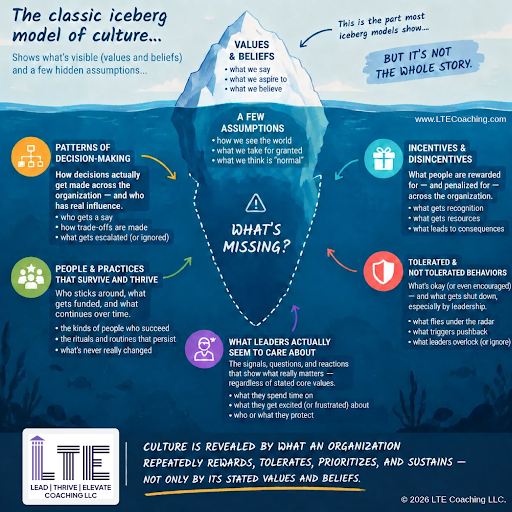
Culture actually includes:
- The patterns of decision making seen across an organization.
- The things that employees are incentivized and disincentivized to do at work.
- The behaviors that are and aren’t tolerated within the organization, especially by leadership.
- The things leaders actually seem to care about, regardless of the company’s core values.
- The people and practices that seem to not just survive but thrive in the organization.
And let’s not forget to acknowledge the additional complexity of the subcultures that can proliferate within an organization at the regional, functional, and/or leader or manager-level.
Remember, a company doesn’t have a heart and soul. The people within it do. You do. So watch what happens when there’s a change in leadership. When the old guard transitions out and a new guard transitions in, the company’s core values may travel with them. And it can render a work environment unrecognizable to someone who has been with an org through multiple transitions.
Here’s my quick advice:
If you’re in leadership, remember that your presence represents what you—and by extension your company—stand for. And your team is watching, responding, and making their own decisions about what that means for their own sustainability in the organization. You are a cultural avatar at minimum; but at best, you can be a beacon for what everyone should aspire to be. Take that responsibility seriously.
If you’re a HR/people leader, reviewing employee engagement and manager survey scores won’t get you to the real, holistic story if the culture at your organization disincentivizes people to speak up. Consider what you can integrate into your current practices to get to the perspectives you may be lacking. Recognize that you are a critical influencer of the culture. Hold your leaders accountable to walking the talk.
And if you’re a job seeker, let this definition of culture guide the questions you ask your potential employer. Ask them to provide examples of their culture and values in action. Ask them to share what they do when someone violates cultural expectations. And then see what you observe once you’re actually in the organization.
Want to have a deeper dive into what’s going on within your organization? Schedule time with me so that we can assess how I can support your needs.